
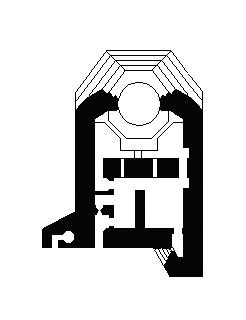
The designation 'M270' marks a solitary, enigmatic military structure situated in the rugged landscape of northern Brittany, France. Its precise coordinates place it within the commune of Saint-Nicolas-du-Pélem, in the Côtes-d'Armor department, nestled within the rocky expanse of the Monts d'Arrée. This region, characterized by its dramatic granite outcrops, heathland, and mist-shrouded moors, has long served as a backdrop for military activity, from ancient Celtic hillforts to the concrete fortifications of the 20th century.
The site itself, however, remains an unverified puzzle. Comprehensive web searches yield no direct information about this specific 'M270' installation, and the provided results concerning France's independent nuclear deterrent (the Force de frappe) and its policy of dissuasion are geographically and contextually unrelated to this small, rural location in Brittany. Consequently, the true nature, origin, and historical purpose of this structure must be approached with caution, relying instead on an understanding of the broader military heritage of the region to provide plausible context and to highlight the critical need for on-site archival or archaeological investigation.
The strategic geography of Brittany, a peninsula jutting into the Atlantic, made it a focal point for military engineering across multiple eras. During the Second World War, the region formed a crucial segment of the Atlantic Wall (Atlantikwall), the extensive coastal defense system constructed by Nazi Germany. While the most famous installations are the massive coastal batteries overlooking the English Channel and the Bay of Biscay, the interior was also threaded with support infrastructure: ammunition bunkers (Munitionsbunker or M types in German nomenclature), command posts, personnel shelters, and roadways.
The 'M' prefix in 'M270' is strongly suggestive of German WWII military engineering classification, often denoting a specific Regelbau (standardized design) type of ammunition storage bunker or similar auxiliary structure. However, the explicit guidance 'Likely German WWII title: false' requires us to dismiss this assumption as a primary conclusion. This forces a re-evaluation: the 'M' could be a post-war French military designation, perhaps from the Cold War era, referencing a local ammunition depot (Munitions), a signals facility (Marine), or a specific type of field fortification.
Without corroborating evidence, the site's temporal allegiance—whether to the German occupation (1940-1944), the post-war French Army, or even a later period—remains an open question, a blank slate upon which the region's layered military history can only be tentatively projected. Architecturally, the surviving remnants visible in satellite imagery and hinted at in the sparse description suggest a small, robust, earth-sheltered concrete structure.
Typical of 20th-century military bunkers in the region, it would likely be constructed from reinforced concrete (béton armé), with thick, sloping walls and a roof designed to withstand shellfire and aerial bombardment. Its location, set back from major roads and nestled into a low rise or embedded in a rocky outcrop, would be consistent with both German WWII Regelbau practices—which emphasized camouflage and dispersion—and later French defensive planning.
The use of local granite would have been practical for foundations and revetments. If it were an ammunition bunker, its design would feature blast doors, internal ventilation systems, and separate compartments to prevent sympathetic detonation. If it served as a personnel shelter or command post, it would include more living space and communication niches.
The absence of any visible large-caliber gun emplacement or extensive trench system in the immediate vicinity suggests it was not a primary combat position but a support or logistic asset. Its current state, described only partially, likely involves partial collapse, overgrowth of gorse and bracken, and the corrosion of any internal fittings, a common fate for isolated French military ruins not maintained as historical sites.
The geographic setting is integral to understanding its potential role. Saint-Nicolas-du-Pélem lies in the heart of the Monts d'Arrée, a granite massif that historically formed a natural barrier and was relatively sparsely populated. This terrain offered both concealment and a challenging environment for construction.
During the German occupation, this interior area was less about direct coastal defense and more about securing rear areas, storing supplies for the coastal strongpoints, and housing troops in reserve. The network of small roads and tracks through the moors would have been vital for logistics. In a Cold War context, the same remoteness and solid geology might have been chosen for a secure ammunition depot for NATO or French forces, or for a radio relay station, leveraging the high ground for signal propagation.
The site's isolation is its defining feature; it is not part of a larger, obvious complex like the preserved batteries at Saint-Malo or Brest, but a solitary outpost, which adds to its mystery and the difficulty of historical attribution. Presently, the 'M270' site exists in a state of limbo. It is not listed in major French military heritage inventories like those maintained by the Ministère des Armées or regional heritage bodies (Inventaire général du patrimoine culturel), nor does it appear on dedicated bunkerology websites focused on the Atlantic Wall or Cold War relics in France.
This absence from the historical record is significant. It could mean the structure was a minor, locally-built facility of little strategic note, quickly forgotten after its use ceased. Alternatively, it might have been demolished or completely repurposed post-military use, leaving only subtle ground traces.
Its current condition is almost certainly one of decay and natural reclamation. Without formal protection, it is vulnerable to the elements, to vandalism, and to the gradual erosion that claims so many concrete relics of the 20th century. This lack of official recognition also means there is no public access information, no interpretive signage, and no preservation plan, leaving its story untold and its physical fabric slowly disappearing.
For military heritage explorers and researchers (bunkerologists), the 'M270' presents a classic case of an unverified site. The journey to this location near Saint-Nicolas-du-Pélem is a journey into the quieter, less-documented chapters of Brittany's wartime landscape. The search for such sites is driven by a desire to piece together the complete picture of a region's defense, beyond the famous museums at Audierne or the preserved U-boat pens at Lorient.
Discovering the true identity of 'M270' would require meticulous fieldwork: detailed photographic documentation, measurement of the structure's dimensions, analysis of concrete composition and reinforcement, and, most critically, intensive archival research in French departmental archives (Archives départementales des Côtes-d'Armor), military archives (Service historique de la défense at Vincennes), and possibly German wartime maps (Kartenmeister).
Local oral history could also be invaluable; elderly residents may recall construction during the war or post-war military activity in the area. The heritage value of such a site, even unverified, is substantial. It represents the countless anonymous fortifications that formed the logistical sinews of larger military operations.
Whether a German ammunition cache from 1943 or a French Cold War depot from the 1960s, it is a tangible artifact of the geopolitical tensions that shaped the 20th century. Its concrete form is a direct link to the strategies of attrition, defense, and deterrence that defined eras. For the local community in the Monts d'Arrée, it is a part of the cultural landscape, a silent witness to the times when this peaceful, rocky countryside was woven into the machinery of global conflict.
Preserving its memory—through documentation, photography, and potentially, if its significance is proven, through conservation—ensures that the narrative of Brittany's military past includes not just the grand coastal strongholds, but also these scattered, humble, and historically ambiguous outposts that dot the interior. In conclusion, the 'M270' near Saint-Nicolas-du-Pélem stands as a compelling historical enigma.
Without confirmed data from web sources or official records, its description must be rooted in the verified military history of Brittany—the Atlantic Wall, the Cold War standoff—and the common architectural forms of 20th-century fortification. Its type is therefore indeterminate, best classified under 'Other' for unverified military structures. Its era is 'Unknown'.
The path forward for understanding this site lies not in speculative online searches, but in boots-on-the-ground research, archival digging, and a commitment to uncovering the stories of the many unnamed concrete relics that quietly populate Europe's former battlefields and defense zones. It is a reminder that military heritage is often found not in the celebrated museums, but in the overgrown, forgotten corners of the map, waiting for a curious historian to ask the right questions.